27 Nakshatras: Complete Map of Lunar Mansions
Learn the 27 nakshatras with rulers, meanings and essence. A clear Vedic guide to lunar mansions for kundli study and self understanding.
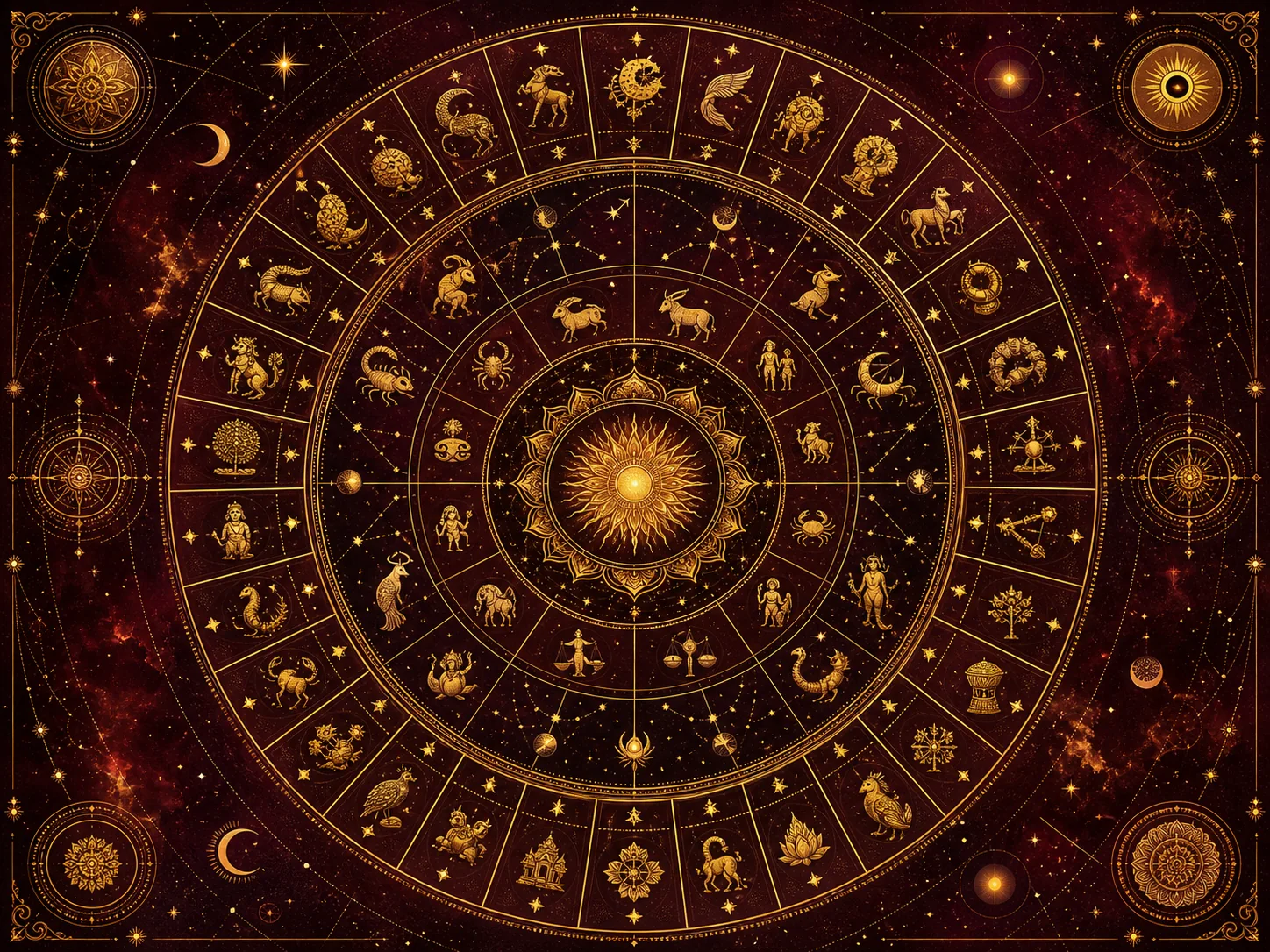
The 27 nakshatras are the lunar mansions of Vedic astrology, forming one of the most important maps for understanding temperament, destiny, compatibility, dasha, and timing. While the zodiac signs show broad qualities, the nakshatras give a more precise and intimate reading of the mind, instinct, motivation, and karmic pattern. In Jyotish, your birth nakshatra, also called Janma Nakshatra, is the nakshatra occupied by the Moon at the time of birth.
This guide is a complete nakshatra chart and library hub. You will find all nakshatras in order, their Vimshottari ruling planet, and a one-line essence for each. Use it as a reference when reading your free kundli, checking compatibility through kundli matching, or studying your dasha sequence.
What Are Nakshatras?
Nakshatras are 27 divisions of the zodiac used in Vedic astrology. Each nakshatra covers 13 degrees 20 minutes of the zodiac. Together, all 27 nakshatras cover the full 360 degrees.
Each nakshatra has four padas, or quarters, of 3 degrees 20 minutes each. These padas connect the nakshatra to the navamsha and add more detail to interpretation.
A nakshatra is not just a star group. It carries a symbolic field of meaning, including:
- A ruling planet for Vimshottari dasha
- A deity or divine force
- A symbol
- A psychological pattern
- A guna and temperament
- A role in marriage matching and muhurta
- A karmic flavour seen through the Moon
For beginners, the simplest starting point is this: the sign shows the environment, while the nakshatra shows the inner impulse.
Why the Moon Nakshatra Matters So Much
In Parashari Jyotish, the Moon is central to lived experience. It represents the mind, emotions, memory, receptivity, and the way we process life. Therefore, the Moon's nakshatra becomes a vital clue to the native's emotional nature and karmic rhythm.
Your Janma Nakshatra is used for:
- Naming syllables in traditional practice
- Vimshottari dasha calculation
- Marriage compatibility through Ashtakoot factors
- Tara Bala and muhurta selection
- Daily panchang interpretation
- Understanding mental and emotional tendencies
This is why Indian astrology gives so much importance to the Moon sign and Moon nakshatra. A person may know their Sun sign, but a Jyotish reading becomes much sharper when the Moon nakshatra is known.
The Vimshottari Ruler Cycle
Each nakshatra is ruled by one of nine planets used in the Vimshottari dasha system. The sequence repeats three times across the 27 nakshatras.
The repeating ruler cycle is:
Ketu, Venus, Sun, Moon, Mars, Rahu, Jupiter, Saturn, Mercury.
This order is not random. It is the foundation of Vimshottari dasha, the 120-year planetary period system widely used in Parashari astrology. The planet ruling your birth nakshatra becomes the starting point of your dasha sequence.
For example, if your Moon is in Ashwini, the starting dasha is Ketu. If your Moon is in Rohini, the starting dasha is Moon. If your Moon is in Anuradha, the starting dasha is Saturn.
Nakshatra Chart: All 27 Nakshatras with Rulers and Essence
The following nakshatra list gives all 27 nakshatras in their traditional order. The ruler shown is the Vimshottari dasha lord.
| No. | Nakshatra | Ruling Planet | One-line Essence |
|---|---|---|---|
| 1 | Ashwini | Ketu | Swift healing, initiative, rescue, and the power to begin before others are ready. |
| 2 | Bharani | Venus | Responsibility, endurance, desire, moral testing, and the capacity to carry life's weight. |
| 3 | Krittika | Sun | Purification, sharp truth, discipline, protection, and cutting away what is impure. |
| 4 | Rohini | Moon | Growth, beauty, fertility, charm, nourishment, and the magnetic pull of creation. |
| 5 | Mrigashira | Mars | Searching, curiosity, restlessness, learning, and the gentle pursuit of what is missing. |
| 6 | Ardra | Rahu | Storm, grief, intensity, breakthrough, and transformation through emotional cleansing. |
| 7 | Punarvasu | Jupiter | Renewal, return, optimism, wisdom, and the ability to rebuild after difficulty. |
| 8 | Pushya | Saturn | Nourishment, duty, tradition, protection, and steady growth through discipline. |
| 9 | Ashlesha | Mercury | Serpent wisdom, strategy, emotional depth, binding power, and psychological insight. |
| 10 | Magha | Ketu | Ancestors, authority, lineage, honour, and the dignity that comes from roots. |
| 11 | Purva Phalguni | Venus | Pleasure, creativity, romance, rest, enjoyment, and the celebration of life. |
| 12 | Uttara Phalguni | Sun | Commitment, patronage, agreements, service, and the maturity to sustain bonds. |
| 13 | Hasta | Moon | Skill, hands, craft, humour, cleverness, and the ability to shape outcomes. |
| 14 | Chitra | Mars | Design, brilliance, beauty, ambition, and the urge to build something striking. |
| 15 | Swati | Rahu | Independence, movement, adaptability, trade, and the wind-like need for freedom. |
| 16 | Vishakha | Jupiter | Focus, ambition, devotion, achievement, and the power to reach a chosen goal. |
| 17 | Anuradha | Saturn | Friendship, loyalty, devotion, discipline, and success through cooperation. |
| 18 | Jyeshtha | Mercury | Seniority, protection, command, responsibility, and the burden of being capable. |
| 19 | Mula | Ketu | Roots, destruction, investigation, truth-seeking, and removing illusion at its base. |
| 20 | Purva Ashadha | Venus | Invincibility, conviction, purification, confidence, and the will to rise. |
| 21 | Uttara Ashadha | Sun | Lasting victory, integrity, leadership, and achievement through righteousness. |
| 22 | Shravana | Moon | Listening, learning, sacred sound, tradition, and knowledge received through attention. |
| 23 | Dhanishta | Mars | Rhythm, prosperity, community, performance, and success through timing and effort. |
| 24 | Shatabhisha | Rahu | Healing, secrecy, research, isolation, and confronting hidden or complex problems. |
| 25 | Purva Bhadrapada | Jupiter | Intensity, idealism, austerity, fire, and the power to awaken through extremes. |
| 26 | Uttara Bhadrapada | Saturn | Depth, patience, stability, compassion, and calm strength beneath the surface. |
| 27 | Revati | Mercury | Protection, travel, nourishment, completion, and guiding souls safely to the next stage. |
How to Read This Nakshatra List
A nakshatra should never be read in isolation. The one-line essence gives the seed meaning, but the full result depends on the planet placed there, the sign, the house, the dignity of the planet, aspects, conjunctions, and the running dasha.
1. Start with the Moon
The Moon's nakshatra is the most personal. It shows how the mind receives life. It can reveal emotional habits, instinctive responses, comfort patterns, and the type of experiences that repeatedly shape the person.
For example, a Moon in Rohini may seek beauty, affection, and stability. A Moon in Ardra may experience life through intensity, storms, and emotional processing. A Moon in Anuradha may grow through loyalty, friendship, and disciplined devotion.
2. Check the Nakshatra Ruler
The nakshatra ruler has a strong role in the interpretation. If your Moon is in a nakshatra ruled by Saturn, Saturn's condition in the chart becomes important. If your Moon is in a nakshatra ruled by Venus, Venus will influence the mental pattern and dasha starting point.
This is especially important during Vimshottari dasha. The dasha lord activates karmas connected to its placement, ownership, strength, and nakshatra links.
3. Consider the Sign and Pada
Nakshatras span across signs in several cases. A nakshatra's meaning is modified by the sign it occupies. For example, Krittika begins in Aries and continues in Taurus. The fiery Aries portion and earthy Taurus portion will not express in exactly the same way.
The pada gives still finer detail. It connects the nakshatra to a navamsha sign and can change the tone of expression.
Nakshatras and Compatibility
Nakshatras play a central role in traditional marriage matching. In Ashtakoot Milan, factors like Tara, Yoni, Gana, Bhakoot, and Nadi are linked to the Moon nakshatra and Moon sign.
This does not mean that one nakshatra alone decides marriage success. A mature compatibility reading must also examine:
- The 7th house and its lord
- Venus and Jupiter, depending on the chart context
- Mars and Mangal Dosha factors
- Navamsha chart
- Dasha periods
- Emotional maturity and family background
- Shared values and practical compatibility
Nakshatra matching is useful, but it is one layer of the full kundli. A high score does not guarantee harmony, and a lower score does not automatically deny marriage. The chart must be read as a whole by a competent astrologer.
Nakshatras in Daily Life and Muhurta
Nakshatras are also used in panchang and muhurta. Every day, the Moon travels through a nakshatra. This daily nakshatra influences the quality of time.
Certain nakshatras are preferred for specific activities. Some are good for learning, some for healing, some for marriage, some for travel, and some for spiritual practice. This is why a traditional astrologer checks the nakshatra along with tithi, vara, yoga, karana, and lagna before selecting an auspicious time.
You can follow the daily Moon nakshatra through today's panchang and observe how different lunar mansions feel in real life.
A Simple Way to Remember the 27 Nakshatras
A beginner may feel overwhelmed by all nakshatras, but the structure is very orderly.
Remember these three points:
- There are 27 nakshatras.
- Each nakshatra has a Vimshottari ruler.
- The nine-ruler cycle repeats three times.
The cycle is:
Ketu, Venus, Sun, Moon, Mars, Rahu, Jupiter, Saturn, Mercury.
The first cycle runs from Ashwini to Ashlesha. The second cycle runs from Magha to Jyeshtha. The third cycle runs from Mula to Revati.
This makes the nakshatra chart easier to memorise. Ashwini, Magha, and Mula are all ruled by Ketu. Bharani, Purva Phalguni, and Purva Ashadha are ruled by Venus. Krittika, Uttara Phalguni, and Uttara Ashadha are ruled by Sun. The same pattern continues until Mercury rules Ashlesha, Jyeshtha, and Revati.
Common Mistakes About Nakshatras
Mistake 1: Reading only the nakshatra name
The nakshatra name gives a clue, but it is not the whole chart. A planet in a nakshatra must be interpreted with house, sign, lordship, strength, aspects, and dasha.
Mistake 2: Calling one nakshatra good and another bad
Every nakshatra has a higher and lower expression. Ashlesha can show manipulation, but also deep psychological intelligence. Mula can show uprooting, but also truth and liberation. Pushya can show nourishment, but also rigidity. No nakshatra should be judged in a simplistic way.
Mistake 3: Ignoring the Moon
In Vedic astrology, the Moon nakshatra is essential. Many people know their rashi but not their Janma Nakshatra. Without the Moon nakshatra, dasha and many compatibility factors remain incomplete.
Mistake 4: Using nakshatras without context
A nakshatra reading is not a substitute for a full kundli. It is a powerful lens, but the complete result comes only when the whole horoscope is studied.
Frequently Asked Questions
1. What are the 27 nakshatras?
The 27 nakshatras are lunar mansions used in Vedic astrology. They divide the zodiac into 27 equal parts of 13 degrees 20 minutes each. They are used for personality, dasha, compatibility, muhurta, and panchang.
2. Which nakshatra is my birth nakshatra?
Your birth nakshatra, or Janma Nakshatra, is the nakshatra occupied by the Moon at your exact time of birth. You need an accurate birth date, birth time, and birth place to calculate it properly.
3. Are nakshatras more important than zodiac signs?
Both are important. Zodiac signs show the broader field of expression, while nakshatras show a finer and more psychological pattern. In Vedic astrology, the Moon nakshatra is especially important for dasha and compatibility.
4. Why do nakshatras have ruling planets?
Nakshatras have ruling planets because they are linked to the Vimshottari dasha system. The ruling planet of the Moon's birth nakshatra determines the starting dasha at birth.
5. Which nakshatra is best?
There is no single best nakshatra. Each nakshatra has strengths, challenges, and a proper field of expression. The result depends on the full chart, the planet placed there, and the maturity of the person.
6. Can nakshatra matching decide marriage?
Nakshatra matching is important in traditional kundli matching, but it should not be the only deciding factor. The full horoscope, navamsha, 7th house, dasha, family context, and practical compatibility must also be examined.
Final Thoughts
The 27 nakshatras form one of the most beautiful and precise systems in Jyotish. They reveal the subtle rhythm of the Moon, the karmic flavour of the mind, and the timing pattern behind Vimshottari dasha. When studied carefully, they turn astrology from a general sign-based reading into a refined map of inner life.
Use this nakshatra chart as a starting point. Learn the order, remember the ruler cycle, and observe how the Moon's nakshatra shapes temperament and timing. For deeper guidance, always read the nakshatra within the complete kundli rather than treating it as a stand-alone label.