Rahu into Capricorn, Ketu into Cancer: The Hunger Moves
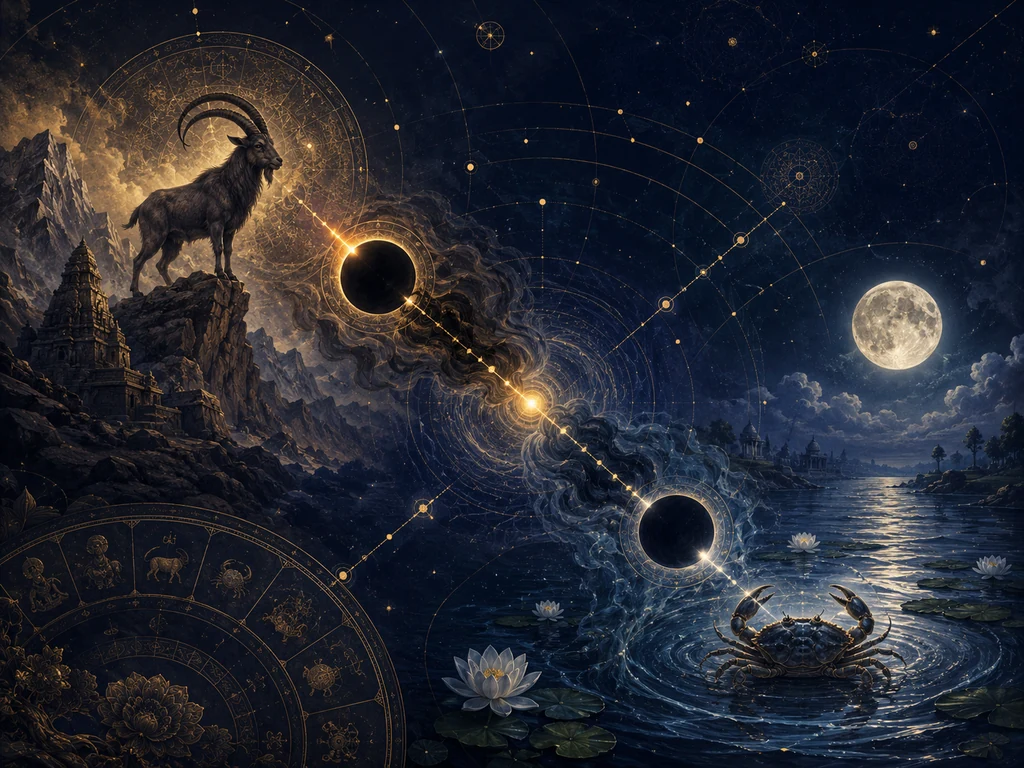
On 26 November 2026, Rahu enters Capricorn and Ketu enters Cancer, shifting desire toward achievement while loosening old emotional dependencies and habits.
What does Rahu in Capricorn and Ketu in Cancer mean?
Rahu’s entry into Capricorn on 26 November 2026 moves collective hunger toward achievement, authority, systems, reputation and measurable results. At the same moment, Ketu enters Cancer and loosens identification with emotional shelter, family roles, inherited habits and the need for constant reassurance. The axis does not abolish home in favour of career; it exposes where ambition has become compulsive and where belonging has become a hiding place.
In Vedic astrology, Rahu and Ketu are chhaya grahas, shadow planets. Rahu magnifies appetite, experimentation and dissatisfaction; Ketu separates, internalises and makes familiar territory feel strangely insufficient. Their transit across Capricorn and Cancer therefore shifts the field of tension rather than creating a simple promise of gain or loss.
The useful question is not, “Will this transit be good or bad?” It is, “Where will desire become louder, and where will attachment lose its old authority?” Your birth chart, current planetary period and the houses occupied by Capricorn and Cancer provide the answer.
“Rahu makes the outer goal feel urgent; Ketu asks whether the inner foundation can survive without its usual forms of reassurance.”
When does the Rahu–Ketu axis shift happen in 2026?
Using the true-node calculation, Rahu enters Capricorn and Ketu enters Cancer on 26 November 2026. Mean-node almanacs may place the sign change in early December, so two competent calendars can show slightly different dates. For personal timing, stay consistent with one nodal method rather than switching systems to obtain a preferred prediction.
The ingress follows several major 2026 developments. Jupiter turns direct in Gemini on 11 March, enters exalted Cancer in a swift atichara passage on 2 June, is combust there from about 14 July to 12 August, and moves into Leo on 31 October. Saturn remains in Pisces throughout the year. From 2 June to 31 October, Jupiter’s ninth aspect falls on Saturn in Pisces; that aspect has ended by the time Rahu enters Saturn’s sign.
This sequence matters because Rahu in Capricorn must deliver through Saturn, Capricorn’s ruler, and Saturn is in Pisces. The new hunger for status, order and accomplishment is therefore routed through Piscean themes: institutions, unfinished endings, sacrifice, distant or secluded environments, compassion, fatigue, faith and the need to give form to what is diffuse. Plans shaped while Jupiter was aspecting Saturn may become the structures pursued more intensely after the nodes shift, but this is context, not a universal prediction.
For local observances, eclipse visibility and daily timing, use a reliable Vedic panchang rather than treating the ingress as the only operative moment.
Why does the hunger move toward Capricorn?
Capricorn is a movable earth sign ruled by Saturn. It concerns consequence, hierarchy, labour, endurance, governance, professional competence and the slow conversion of effort into standing. Rahu does not simply “improve career” here. It enlarges the desire to enter closed rooms, master difficult systems, acquire credentials, command resources or become indispensable.
Constructively, Rahu in Capricorn can support strategic ambition, technical learning, institutional reform and willingness to work beyond inherited limits. Distorted, it can produce status anxiety, opportunism, performative seriousness, obsession with metrics and the belief that visibility equals value. Rahu’s appetite is hard to satisfy because each achievement quickly becomes evidence that a larger one is required.
Capricorn is the natural tenth sign, but it is not automatically the tenth house in every chart. A Cancer ascendant experiences Capricorn in the seventh house; an Aries ascendant experiences it in the tenth; a Virgo ascendant experiences it in the fifth. Natural-zodiac symbolism describes the atmosphere. House placement describes where the transit acts.
Classical Jyotisha repeatedly insists on synthesis. Brihat Parashara Hora Shastra gives primacy to houses, house lords, planetary strength, aspects and planetary periods. Phaladeepika and Saravali likewise judge results through condition and relationship rather than a single isolated placement. “Rahu in Capricorn is always excellent” is therefore not a classical conclusion.
Why does Ketu in Cancer unsettle familiar security?
Cancer is a movable water sign ruled by the Moon. It signifies nourishment, memory, emotional continuity, home, protection, ancestry and the instinct to form a safe enclosure. Ketu entering Cancer can make these supports feel less complete. A person may remain devoted to family yet feel unable to keep performing an inherited role. A house may be comfortable yet no longer feel like a centre.
This is not automatically loss. Ketu often reduces fascination before it removes anything tangible. Its deeper work is discrimination: what is genuine care, and what is dependency disguised as care? What is a living family bond, and what is repetition maintained by guilt? What is rest, and what is retreat from necessary responsibility?
Because the Moon rules Cancer, the Moon’s natal dignity and current condition matter greatly. A supported Moon can make Ketu’s detachment reflective and clarifying. A pressured Moon, especially during a relevant dasha, may experience the same transit as emotional dryness, uncertain belonging or irregular domestic rhythms. The Rahu–Ketu learning guide explains the shared nodal principle; here the point is that Ketu in Cancer asks for steadiness that does not depend on constant emotional confirmation.
How do you read this transit in a birth chart?
Begin with the ascendant. The Capricorn house shows where Rahu intensifies appetite and worldly experimentation. The Cancer house shows where Ketu simplifies, questions attachment or redirects attention inward. Read the two houses as one circuit: overinvestment at one end often draws energy away from the other.
Then judge Saturn, because Saturn disposits Rahu in Capricorn, and judge the Moon, because the Moon disposits Ketu in Cancer. A dispositor is the ruler that provides the conditions through which a planet acts. A strong Saturn can give Rahu’s ambition a workable container; a damaged or heavily pressured Saturn may bring delay, bureaucracy, fear or overwork. A steady Moon can turn Ketu toward clarity; an unstable Moon can make emotional withdrawal harder to interpret.
Next inspect conjunctions and classical aspects. A node crossing a natal planet is more personal than a node merely entering a sign. The transit becomes louder near the ascendant, Moon, Sun, ascendant lord, tenth lord or fourth lord, depending on the question. Degree-based claims require a dependable birth time.
Finally, place the transit inside the dasha. Parashari practice does not treat transit as a free-standing engine. Rahu, Ketu, Saturn or Moon periods can make this axis much more audible, as can periods of the lords of the Capricorn and Cancer houses. Jaimini methods can add sign-based aspects, chara karakas and arudha considerations, but they should be used coherently rather than mixed casually with Parashari rules.
Should you read from the ascendant or the Moon?
Read from both, but do not make them interchangeable. The ascendant more often describes circumstances, embodiment, roles and concrete fields of action. The Moon describes lived experience, mental emphasis and the way events are absorbed. A transit can therefore look productive from the ascendant while feeling draining from the Moon.
For public standing, some practitioners also inspect the relevant arudha in Jaimini-oriented work. That can help when Rahu changes perception before it changes formal employment. Yet the arudha layer should refine the reading, not replace the natal house, its lord and the operating dasha.
A generic yearly horoscope can describe the broad field, but personal judgement begins only when the transit is mapped to an individual chart.
Worked example: Aries ascendant with Moon at 18° Aquarius
Consider a native with Aries rising at 12° and the Moon at 18° Aquarius. On 26 November 2026, Rahu enters Capricorn, the tenth house from the ascendant, while Ketu enters Cancer, the fourth. From the Moon, Rahu moves through the twelfth sign and Ketu through the sixth.
Rahu in the tenth can intensify career ambition, visibility, responsibility and the desire to enter a more consequential professional arena. Ketu in the fourth can reduce satisfaction with familiar domestic arrangements, create distance from an old home identity or prompt simplification of property and family obligations. Because the signs occupy an angular axis, career and home decisions are likely to speak to each other.
The Moon-based reading modifies this. Rahu in the twelfth from Aquarius can increase expenditure, foreign links, remote work, sleep disruption, backstage activity or work inside large institutions. Ketu in the sixth from the Moon may reduce interest in petty conflict, but it can also produce an uneven relationship with routine. The native may appear to advance professionally while privately leaking energy through irregular rest or poorly bounded commitments.
Now judge the dispositors. Saturn, ruler of Capricorn, is transiting Pisces throughout 2026, the twelfth house from this Aries ascendant and the second from the Aquarius Moon. Rahu’s tenth-house ambition is therefore delivered through twelfth-house Saturnian conditions: international organisations, hospitals, research settings, remote teams, confidential work, sacrifice or higher overheads. Career growth may be real, but it may demand seclusion, relocation, reduced leisure or careful expense management.
The Moon rules Cancer, so its natal condition is decisive for Ketu in the fourth. If natal Saturn supports the Moon and the dasha activates the tenth or eleventh houses, the native may deliberately trade an old domestic pattern for a larger professional mandate. If the Moon is afflicted and a difficult Moon–Ketu period operates, the same change may feel like alienation rather than chosen simplification.
This is why slogans fail. “Rahu in the tenth gives success” ignores the twelfth-house dispositor. “Ketu in the fourth causes loss of home” ignores the Moon, dasha and actual fourth-house condition. A responsible reading states the pressure, the possible manifestations and the factors that decide among them.
What areas of life become most sensitive?
The Capricorn–Cancer axis makes the boundary between public duty and private nourishment more visible. Work that consumes every evening may become impossible to romanticise. Family arrangements built around one person’s unpaid emotional labour may require renegotiation. An institution may demand proof of competence just as the individual loses interest in being endlessly available at home.
For some charts, the transit is mainly professional. For others, Capricorn and Cancer fall across finances, education, health, partnership or spiritual practice. Natural symbolism remains useful, but house placement wins. This is why a personalised transit report should explain the axis through ascendant, Moon, dashas and dispositors rather than repeat twelve sign-based predictions.
The transit can also expose a false choice. Capricorn without Cancer becomes sterile achievement; Cancer without Capricorn becomes enclosure. The mature use of the axis is not to abandon tenderness for status, but to build structures that protect what genuinely matters.
When will the transit feel strongest?
The first weeks after 26 November can register as a change of emphasis, especially for people already in Rahu, Ketu, Saturn or Moon periods. Stronger manifestations usually require reinforcement: a node contacting a natal planet, the relevant house lord becoming active, an eclipse touching the same axis, or a dasha linking the houses involved.
The ingress is not a universal event deadline. Many people will notice the shift gradually through changing priorities. Others may experience an external event near the date because their natal chart is already primed. The difference is not inconsistency; it is how transit astrology works.
Birth-time uncertainty also matters. A small error may alter the ascendant degree, divisional charts or house-based judgement. When the question concerns marriage, litigation, surgery, investment or relocation, do not rely on one transit statement.
What should you do during Rahu in Capricorn and Ketu in Cancer?
Give ambition a container. Define what result would actually be sufficient before Rahu turns every milestone into another beginning. Put authority, compensation, workload and decision rights in writing. Capricorn rewards accountability, but Rahu can tempt people to accept impressive titles attached to vague powers or hidden costs.
At the Cancer end, simplify without becoming emotionally unavailable. Review what “being there for family” means in practice. Preserve sleep, meals, privacy and a usable home rhythm even when professional demands rise. Ketu’s lesson is not indifference; it is care without compulsive fusion.
Traditional remedial work is most credible when it reinforces conduct. Saturn’s role favours patience, clean obligations, respect for time and willingness to repair neglected duties. Moon-related balance favours regular nourishment, emotional honesty and stable daily rhythms. Mantra, worship and charity may support those disciplines, but they are not substitutes for practical action.
Do not prescribe gemstones merely because the nodes change signs. Strengthening a planet without judging lordship, dignity and the whole chart can amplify the wrong function. For consequential decisions, consult an experienced Vedic astrologer who can explain the reasoning rather than offer a one-line verdict.
Myths and cautions about the 2026 nodal shift
Rahu in Capricorn does not guarantee promotion, political power or wealth. It can produce access and appetite without peace, and it can magnify conflict with systems as easily as success within them. Ketu in Cancer does not automatically mean separation from family, harm to the mother or sale of property. Such outcomes require much more specific chart testimony.
Nor is Ketu always “spiritual” in a pleasant sense. Detachment can be wisdom, fatigue, avoidance or simple loss of interest. Rahu is not always materialistic either; in Capricorn it may obsess over mastery, reform, technical excellence or institutional impact rather than money alone.
Astrology is a tool for guidance and reflection, not a substitute for medical, legal or financial advice. Use it to ask better questions, not to bypass qualified professionals or evidence.
Is Rahu in Capricorn good for career?
It can be powerful for career when Capricorn is connected to professional houses, Saturn can carry the transit, and the dasha supports advancement. It often increases appetite for responsibility, rank and difficult work. The same placement can also bring politics, overextension or dissatisfaction with every achieved result. “Good” depends on whether ambition is disciplined and whether the chart can sustain the cost.
Is Ketu in Cancer bad for home and family?
Not inherently. Ketu may reduce attachment to an old domestic identity, encourage simpler living or reveal where emotional care has become obligation without warmth. Difficult outcomes are more likely only when the fourth house, Moon, relevant dasha and other transits repeat the same theme. Many people experience clarity rather than rupture.
Which date should be used: 26 November or early December 2026?
Use 26 November 2026 for the true-node ingress specified here. Mean-node calendars may show early December. Both are mathematical conventions for representing the lunar nodes. Consistency matters more than switching between them from one prediction to another.
Does Jupiter protect Cancer when Ketu enters it?
Jupiter is no longer in Cancer when Ketu enters on 26 November. Jupiter’s swift exalted passage through Cancer runs from 2 June until 31 October 2026, with combustion from about 14 July to 12 August; Jupiter then enters Leo. Any benefit from Jupiter’s earlier Cancer transit must be judged as preparation or context, not as a conjunction with Ketu at the ingress.
When should you not worry about this transit?
Do not worry merely because an online post labels Rahu or Ketu dangerous. Concern is unwarranted when the prediction ignores houses, dispositors, dasha, natal planets and the difference between ascendant and Moon. A strong chart may use the same axis for disciplined advancement and emotional simplification. Even a difficult activation is a period to manage consciously, not a sentence