The 27 Nakshatras in One Map: What Yours Carries
The 27 nakshatras divide the sidereal zodiac into lunar fields. Your birth star shows the Moon’s instinctive pattern and the timing it activates in life.
What are the 27 nakshatras, exactly?
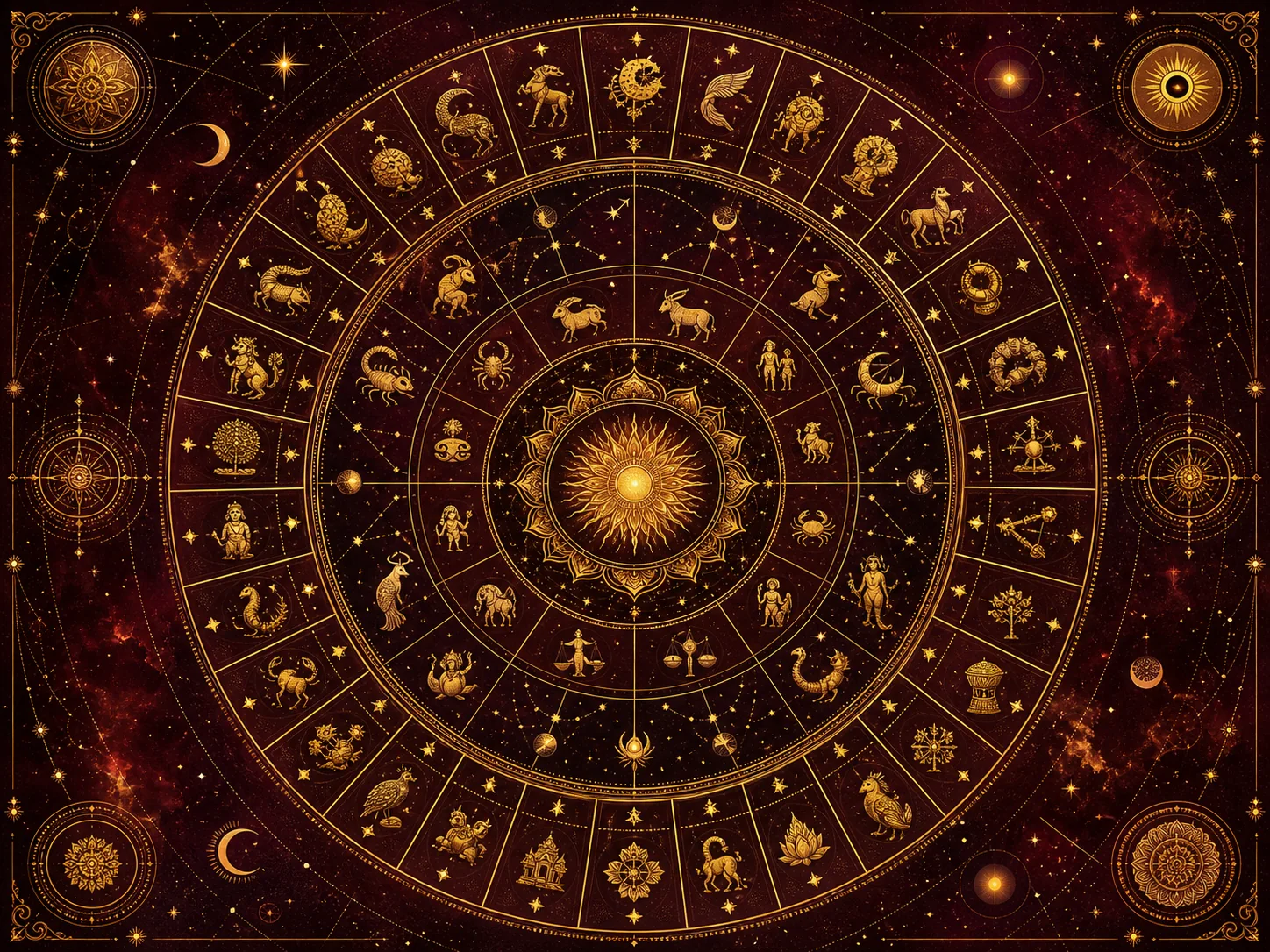
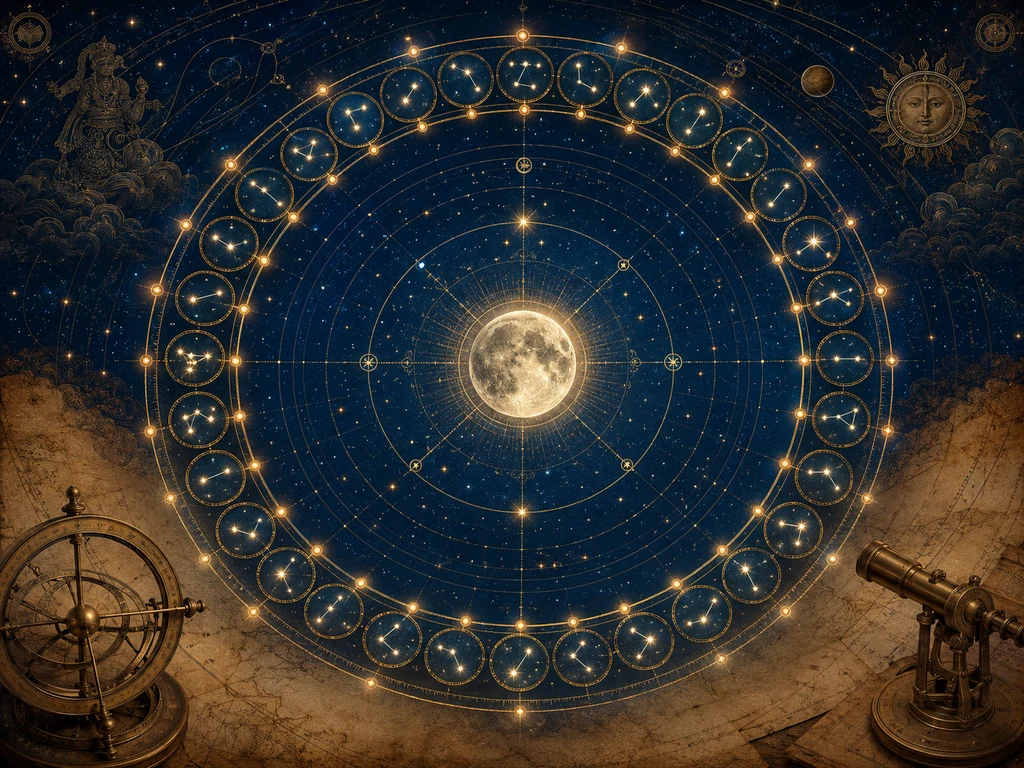
A nakshatra is a measured sector of the sidereal zodiac through which the Moon travels, not merely a personality label. The 360-degree circle is divided into 27 fields of 13°20′ each, and every field into four padas, or quarters, of 3°20′. Your birth nakshatra, or janma nakshatra, is the field occupied by the sidereal Moon at birth.
The sign gives the Moon’s broad environment; the nakshatra gives its operating pattern. A Taurus Moon may seek steadiness, yet Rohini, Mrigashira and the Taurus portion of Krittika pursue it through cultivation, searching and refinement respectively. This is why people with the same Moon sign can have very different emotional rhythms.
The predictive map normally uses 27 nakshatras. Abhijit is added in certain electional traditions, but it is not inserted into the ordinary 27-fold sequence used for nakshatra rulers and Vimshottari timing.
How do you find your birth nakshatra?
Use an accurate date, time and place of birth to calculate a sidereal kundli. The Moon’s longitude identifies the nakshatra immediately. A Moon at 18° Aquarius falls in Shatabhisha because that field extends from 6°40′ to 20° Aquarius.
The ayanamsha must be consistent because it converts tropical positions to the sidereal zodiac. If the Moon lies near a boundary, even a small timing or software-setting error can shift the birth star and alter the opening dasha balance.
A daily panchang shows the Moon’s current nakshatra, but it does not replace a natal calculation. The Rashtriya Panchang published by the Positional Astronomy Centre is a useful reminder that Indian calendrical data rests on astronomical position, not impression.
Why do the nakshatra rulers repeat in groups of nine?
The ruler sequence is Ketu, Venus, Sun, Moon, Mars, Rahu, Jupiter, Saturn and Mercury, repeated three times around the zodiac. This order supplies the planetary sequence used in Vimshottari dasha.
The ruler is not the deity, symbol or sign lord. The ruler links the placement to another planet in the chart; the deity describes its governing intelligence; the symbol gives an image; and the sign lord provides the zodiacal environment.
The first arc: Ashwini to Ashlesha
Ashwini, 0°–13°20′ Aries, is ruled by Ketu and associated with the Ashvin twins. It carries speed, remedy, rescue and initiation. Its gift is rapid response; its correction is accepting that some processes cannot be hurried.
Bharani, 13°20′–26°40′ Aries, is ruled by Venus and associated with Yama. It carries bearing, containment, desire, consequence and respect for limits. Pressure becomes productive when responsibility equals appetite.
Krittika, 26°40′ Aries–10° Taurus, is ruled by the Sun and associated with Agni. It cuts, heats, purifies and separates the useful from the unfit. Clarity is its gift; needless severity is its excess.
Rohini, 10°–23°20′ Taurus, is ruled by the Moon and associated with Prajapati. It carries growth, attraction, fertility and embodiment. It flourishes through patient cultivation but can cling to comfort or beauty.
Mrigashira, 23°20′ Taurus–6°40′ Gemini, is ruled by Mars and associated with Soma. It carries curiosity, movement and the searching mind. Inquiry becomes intelligence when it has method.
Ardra, 6°40′–20° Gemini, is ruled by Rahu and associated with Rudra. It carries storms, exposure, grief, technical penetration and renewal after disruption. It should never be reduced to catastrophe.
Punarvasu, 20° Gemini–3°20′ Cancer, is ruled by Jupiter and associated with Aditi. It carries return, restoration and renewed shelter. Its deeper pattern is recovery of a sound centre.
Pushya, 3°20′–16°40′ Cancer, is ruled by Saturn and associated with Brihaspati. It carries nourishment through teaching, structure, duty and dependable care. Responsibility must not replace emotional presence.
Ashlesha, 16°40′–30° Cancer, is ruled by Mercury and associated with the Nagas. It carries binding, penetration, instinct and strategic sensitivity. Perception becomes wisdom when it is not used manipulatively.
The middle arc: Magha to Jyeshtha
Magha, 0°–13°20′ Leo, is ruled by Ketu and associated with the ancestral Pitris. It carries inheritance, rank, continuity and the obligation attached to authority.
Purva Phalguni, 13°20′–26°40′ Leo, is ruled by Venus and associated with Bhaga. It carries enjoyment, attraction, creative release and union. Pleasure works best when it restores rather than governs life.
Uttara Phalguni, 26°40′ Leo–10° Virgo, is ruled by the Sun and associated with Aryaman. It carries agreements, patronage and bonds formalised through duty. Its concern is what makes partnership durable.
Hasta, 10°–23°20′ Virgo, is ruled by the Moon and associated with Savitar. It carries the hand: shaping, arranging, repairing and making intention tangible. Skill grows through repetition.
Chitra, 23°20′ Virgo–6°40′ Libra, is ruled by Mars and associated with Tvashtar. It carries design, brilliance, architecture and striking form. Its lesson is to build substance beneath appearance.
Swati, 6°40′–20° Libra, is ruled by Rahu and associated with Vayu. It carries independence, adaptability, trade and negotiation. Freedom needs an inner axis rather than avoidance of commitment.
Vishakha, 20° Libra–3°20′ Scorpio, is ruled by Jupiter and associated with Indra and Agni. It carries branching choices, competitive purpose and focused achievement. Ambition must continue serving a worthy aim.
Anuradha, 3°20′–16°40′ Scorpio, is ruled by Saturn and associated with Mitra. It carries friendship, devotion, alliance and disciplined connection. Loyalty must not become silence before imbalance.
Jyeshtha, 16°40′–30° Scorpio, is ruled by Mercury and associated with Indra. It carries seniority, protection, competence and the burden of being expected to know.
The final arc: Mula to Revati
Mula, 0°–13°20′ Sagittarius, is ruled by Ketu and associated with Nirriti. It carries uprooting, investigation and the need to reach the root. It is not a sentence of loss.
Purva Ashadha, 13°20′–26°40′ Sagittarius, is ruled by Venus and associated with the waters. It carries cleansing, declaration, invigoration and conviction. Confidence needs evidence and receptivity.
Uttara Ashadha, 26°40′ Sagittarius–10° Capricorn, is ruled by the Sun and associated with the Vishvadevas. It carries universal principles, responsibility and achievement meant to last.
Shravana, 10°–23°20′ Capricorn, is ruled by the Moon and associated with Vishnu. It carries listening, learning, transmission, reputation and the paths by which knowledge travels.
Dhanishtha, 23°20′ Capricorn–6°40′ Aquarius, is ruled by Mars and associated with the Vasus. It carries rhythm, resources, performance and contribution to a larger field. Force succeeds through timing.
Shatabhisha, 6°40′–20° Aquarius, is ruled by Rahu and associated with Varuna. It carries enclosure, diagnosis, secrecy, systems and rigorous observation. Distance can protect concentration but also block help.
Purva Bhadrapada, 20° Aquarius–3°20′ Pisces, is ruled by Jupiter and associated with Aja Ekapada. It carries intensity, idealism and austerity. Conviction must become ethical steadiness rather than extremity.
Uttara Bhadrapada, 3°20′–16°40′ Pisces, is ruled by Saturn and associated with Ahirbudhnya. It carries depth, stillness, endurance and support beneath the visible surface.
Revati, 16°40′–30° Pisces, is ruled by Mercury and associated with Pushan. It carries nourishment, safe passage, guidance and completion. It closes the map by delivering something intact to its next destination.
How do you read a nakshatra in a birth chart?
Begin with the planet, because the Moon in Shatabhisha is not the same as Venus there. The planet shows the faculty; the house shows the life arena; the sign shows the environment; the nakshatra shows the mode of delivery; its ruler carries the result onward; and the pada refines expression through the navamsha.
Then judge dignity, house lordship, conjunctions, aspects and yogas. Phaladeepika and Saravali repeatedly condition planetary results by placement, strength, association and context; they do not support isolating one attractive symbol from the horoscope.
“A nakshatra does not replace the chart; it tells you how a planet delivers the chart.”
This is why online descriptions often feel only partly true. The star may describe the style accurately while its ruler, house or affliction changes where and how that style appears.
Worked example: Moon at 18° Aquarius
Consider a hypothetical chart with Libra rising and the Moon at 18° Aquarius in the fifth house. Aquarius adds a concern with systems, groups and durable structures; the fifth house brings learning, authorship, creativity and children. At 18° Aquarius the Moon occupies Shatabhisha pada four, the Pisces navamsha quarter, ruled at the nakshatra level by Rahu and associated with Varuna.
I would not stop at “secretive.” I would look for a mind that restores order by withdrawing, observing patterns and naming what others avoid. The fifth-house emphasis may appear through research, specialist teaching or technical creativity, while the Pisces quarter adds imagination and permeability.
Suppose Rahu is at 9° Aries in the seventh house. The Moon’s themes are then carried towards clients, partners, negotiation and intense one-to-one encounters. Because Rahu’s dispositor, aspects and strength remain unjudged, this is still provisional. A complete horoscope must test whether the pattern repeats.
The timing calculation is precise. Shatabhisha ends at 20° Aquarius, leaving 2° of its 13°20′ span. About fifteen per cent remains, so roughly fifteen per cent of Rahu’s eighteen-year Vimshottari period remains at birth: about two years and eight months, subject to calendrical convention. The Brihat Parashara Hora Shastra is the classical source most often cited for this framework; see our fuller guide to Vimshottari dasha.
When does your nakshatra become active?
The birth star becomes louder during the mahadasha or antardasha of its ruler, when the planet placed there is activated, or when major transits contact the Moon, the ruler or the relevant house. A transit does not manufacture a promise absent from the chart; it opens a window for what is already shown.
The Moon’s monthly return to the birth nakshatra can be observed as a personal rhythm, but one return is too brief for major prediction. Track mood, workload and recurring conversations for several months. Electional suitability is a separate judgement involving the wider panchang and the purpose of the act.
Compatibility also needs more than matching star names. Moon-based factors must be integrated with the seventh house, Venus, Jupiter, relevant lords and the whole promise of relationship. A nakshatra compatibility check is a beginning, not a verdict.
What should you do with your nakshatra knowledge?
Verify the degree, identify the ruler, inspect that planet’s placement and watch its periods and repeated transit triggers. This turns symbolism into an accountable method.
Use the nakshatra’s constructive verb rather than its stereotype. Ashwini can initiate, Bharani can contain, Krittika can refine, Punarvasu can restore, Hasta can craft, Anuradha can ally, Mula can investigate and Revati can guide.
Do not prescribe gemstones, fasts or costly remedies from the birth star alone. Remedial practice should follow the whole chart, running period and real circumstances. When the birth time is uncertain, consult an experienced Vedic astrologer rather than forcing precision from unstable data.
Does a difficult nakshatra mean a difficult life?
No. Fierce imagery describes a kind of work, not a guaranteed event. Ardra can rebuild after disruption, Mula can become a researcher and Jyeshtha a protector. A gentle nakshatra can also function poorly when its planet, ruler or house is compromised.
Nakshatras describe capacities, appetites, thresholds and modes of response. They do not divide people into fortunate and doomed. Classical astrology judges strength and context; responsible practice also leaves room for education, choice, environment and maturity.
Gandanta boundaries deserve care but not panic. They mark sensitive junctions and require accurate degrees, planetary condition and dasha context. They should never be used to frighten parents or reduce a life to one birth factor.
Is the Moon nakshatra more important than the Sun sign?
For many Parashari techniques, the Moon’s nakshatra has special importance because it anchors Vimshottari dasha and lunar timing practices. That does not make the Sun, ascendant or other planets dispensable.
The useful question is whether the ascendant, Moon, Sun and active dasha repeat the same message. Repetition creates confidence; contradiction calls for a conditional reading.
What if the Moon is on a nakshatra boundary?
Check the exact longitude, ayanamsha, birth time and software settings. The Moon moves fast enough that a boundary error can change the ruler and opening dasha balance. Rectification may be warranted when the recorded time is approximate.
Do not blend two nakshatras simply because the Moon is close to the edge. The calculated position belongs to one sector; nuance comes from the sign transition, pada, aspects and ruler.
Can two people with the same birth nakshatra be very different?
Yes. They may occupy different padas, houses and ascendants; their rulers may be strong in one chart and afflicted in another; and they may be living different dashas. Family, culture, education and choice also shape expression.
The birth nakshatra is a precise starting coordinate, not a complete biography. Read it as the layer linking the Moon’s instinct, the planetary network and the timing sequence. Used this way, the 27 nakshatras become neither labels nor fatalistic boxes, but a disciplined language for how potential moves through time.
Astrology is best used for guidance and reflection. It is not a substitute for medical, legal or financial advice, and serious decisions should be made with appropriately qualified professionals.
The source checks use the India Meteorological Department’s official Rashtriya Panchang page and the archived English text of Brihat Parashara Hora Shastra, including Chapter 46 on planetary periods. mausam.imd.gov.in+1