Pitra Dosha: Reading Ancestral Debt in the Birth Chart
Pitra Dosha points to repeated ancestral strain in a birth chart. Learn how astrologers judge its houses, timing, remedies, myths, and chart patterns.
Pitra Dosha is best understood as a repeated pattern of strain around ancestry, lineage duty, family continuity, or the father principle—not as a single universally codified curse. In a chart, it is judged only when the ninth house, its lord, the Sun, and supporting lineage indicators show converging affliction, especially when their planetary periods activate the same theme. One difficult placement is never enough.
What does Pitra Dosha actually mean?
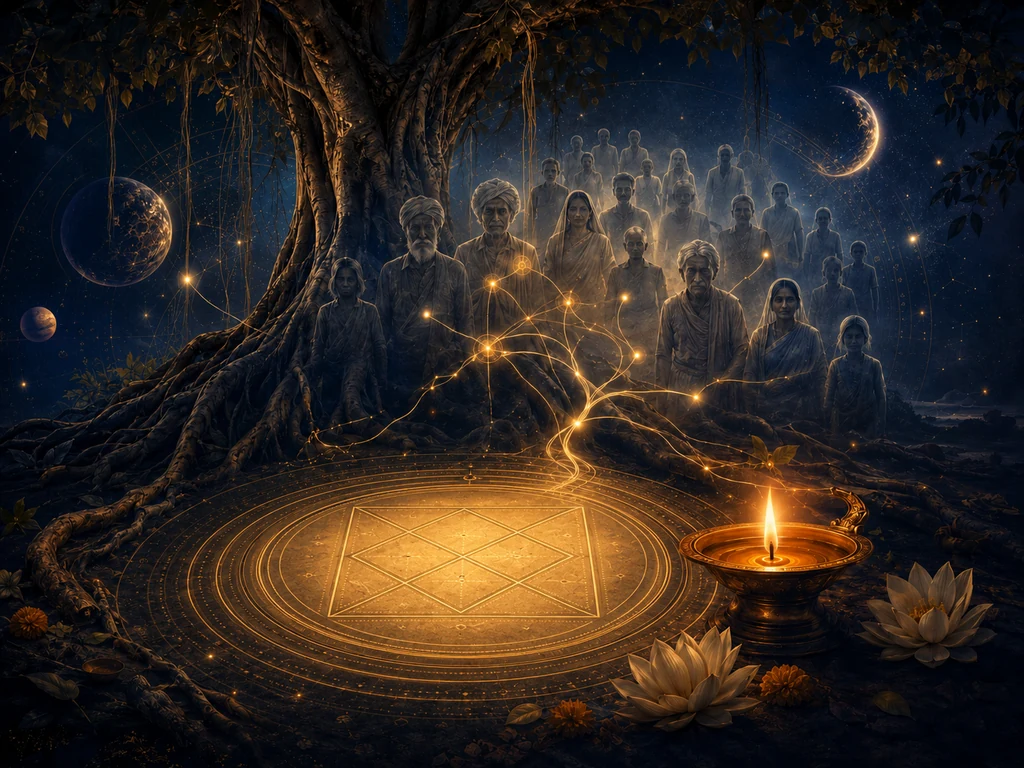
Pitra means forefather or ancestor, while dosha means a fault, imbalance, or condition requiring attention. In contemporary practice, Pitra Dosha has become an umbrella term for chart patterns suggesting unfinished obligations within the family line: unresolved grief, broken responsibility, disputed inheritance, interrupted rituals, estrangement from parents, secrecy, or inherited behavioural patterns that continue across generations.
That definition needs restraint. The major classical works do not present one universally agreed formula labelled “Pitra Dosha” in the modern checklist sense. Rather, texts such as Brihat Parashara Hora Shastra (BPHS), Phaladeepika, and Saravali teach the houses, lords, natural significators, planetary strength, aspects, and periods from which an astrologer may infer ancestral strain. Readers wishing to examine the source tradition can consult an English translation ofBrihat Parashara Hora Shastra and V. Subrahmanya Sastri’s translation ofPhaladeepika.
The diagnosis is therefore synthetic. It comes from repeated testimony in the chart, not from spotting Rahu beside the Sun and declaring a curse.
“An ancestral signature is meaningful when several chart factors tell the same story and the running period gives that story a date.”
This distinction protects the client from fear. A chart can show a demanding family inheritance without promising tragedy. It may describe the person who must restore order, speak an avoided truth, care for elders, settle property, preserve a tradition, or consciously end a harmful pattern.
Which houses show ancestral karma in a birth chart?
The ninth house is the first place to examine because it carries father, forebears, dharma, blessings, teachers, and the continuity of values. BPHS and later classical compendia consistently treat house judgment through the condition of the house, its lord, its occupants, aspects, and the relevant significator. For ancestral matters, the ninth cannot be read in isolation from the Sun.
The Sun is the natural significator of father, authority, vitality, honour, and the principle by which a lineage declares its identity. A weak, eclipsed, severely afflicted, or poorly supported Sun may describe difficulty receiving guidance, recognition, or legitimacy from the paternal line. Yet a strong Sun in its own or exaltation sign can retain dignity even when placed in a difficult house. Strength modifies affliction; it does not erase context, but it changes the outcome.
The fifth house also matters because it shows purva punya, inherited merit, intelligence, children, and what the native transmits forward. When the ninth speaks of what comes from behind us, the fifth often shows what continues through us. The second house adds family culture, speech, stored wealth, food habits, and the visible continuity of the clan. The eighth house can reveal inheritance, secrecy, death-related obligations, shared assets, and matters buried within the family system.
The Moon is especially important for emotional inheritance, memory, belonging, and the maternal atmosphere. Saturn can show age, duty, neglect, delay, poverty consciousness, or the burden of carrying what previous generations could not resolve. Rahu and Ketu may intensify rupture, taboo, foreignness, obsession, or discontinuity. None of these planets creates Pitra Dosha alone.
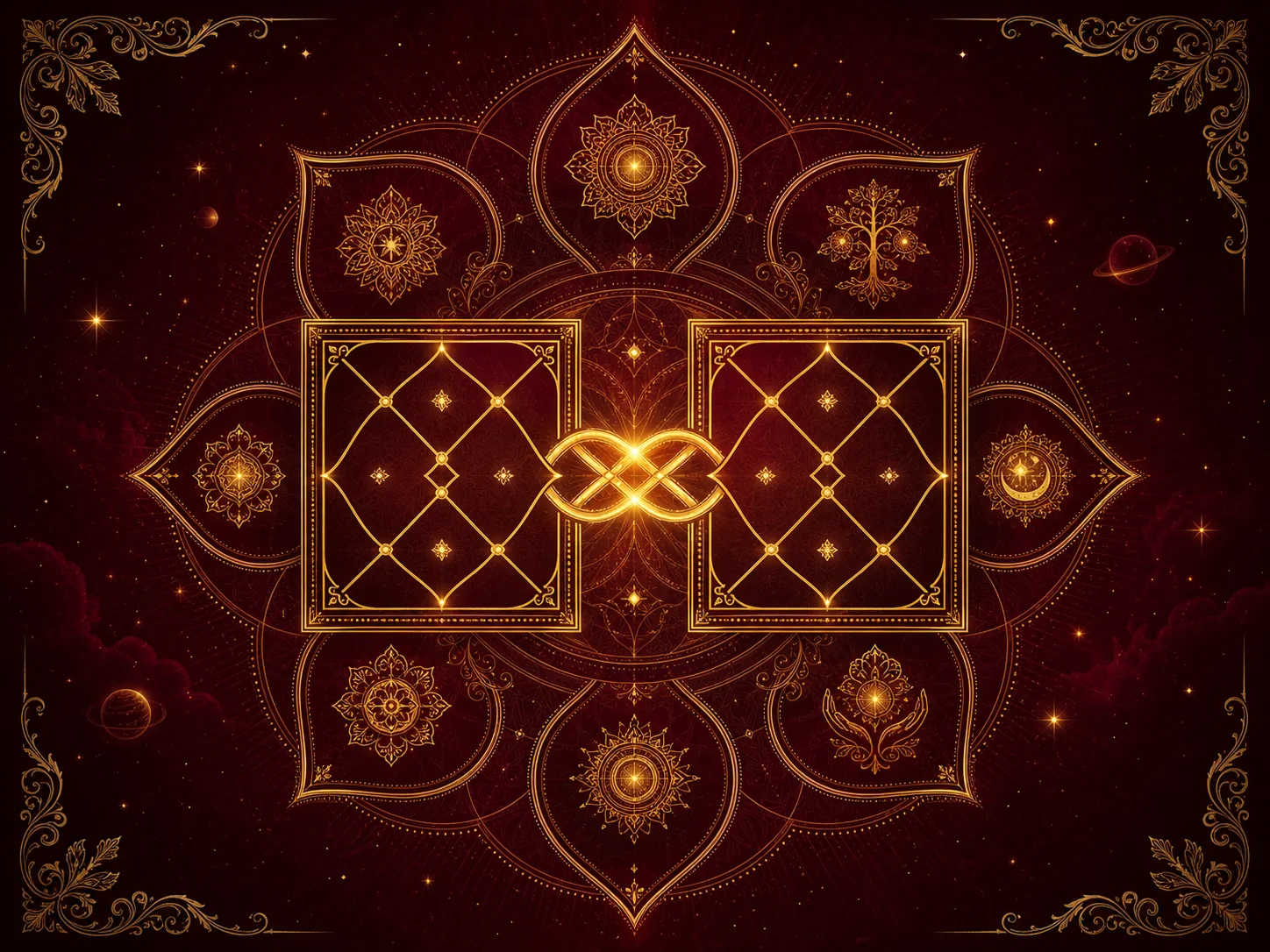
For a complete reading, begin with the birth-chart framework, then confirm the same story through divisional strength where appropriate. The Navamsha may refine planetary dignity and dharma, but it should not be used to manufacture an affliction absent from the main chart.
How do astrologers decide whether the pattern is real?
A careful astrologer looks for convergence. The ninth house may be occupied by a node, while the ninth lord is placed in the eighth or twelfth and receives pressure from Saturn or Mars. The Sun may repeat the theme through conjunction, combustion, debility, enclosure by malefics, or association with the same damaged lord. The second or fifth house may then echo the story through family discontinuity, child-related anxiety, inheritance disputes, or a break in tradition.
Even then, benefic support matters. Jupiter’s aspect, a strong dispositor, an unafflicted ascendant lord, or a planet in its own sign can give intelligence and capacity to handle the inherited burden. Phaladeepika and Saravali repeatedly insist, in their broader methods, that planetary results change according to sign dignity, house ownership, association, and aspect. A malefic influence is not interpreted mechanically.
The most reliable test is whether the chart shows the same theme in at least three layers: the house, its lord, and the significator. Repetition through the second, fifth, or eighth strengthens the case. Repetition in the running dasha gives timing. Without this convergence, it is more accurate to describe a specific father, family, inheritance, or belief-system issue than to use the loaded label Pitra Dosha.
Jaimini methods may add another perspective through sign-based aspects and the relevant chara karaka scheme used by the practitioner. They should confirm, not contradict, the central promise of the birth chart.
What does Pitra Dosha feel like in real life?
The lived expression is often quieter than popular astrology suggests. A person may feel responsible for holding a fragmented family together. They may inherit debt, land disputes, caregiving duties, silence around a death, or a family profession they are expected to continue. Sometimes the pattern appears as emotional distance from the father, repeated conflict with authority, difficulty accepting support, or guilt when choosing a life different from the family’s expectations.
Another expression is repetition. Similar marriages fail across generations. The same addiction, secrecy, financial instability, or emotional absence returns in a new form. Astrology does not prove that an ancestor caused the event, nor does it replace social, psychological, or medical explanation. It offers a symbolic map showing where the native may be carrying more than an individual story.
A strong chart can turn this pattern into stewardship. The native becomes the archivist, mediator, ethical heir, therapist, researcher, ritual keeper, or practical reformer of the family system. The same eighth- and ninth-house connection that produces inherited complexity may also produce deep historical intelligence, interest in genealogy, spiritual inquiry, or skill in handling estates and confidential matters.
When does ancestral karma become active?
Natal promise comes first; timing comes second. A person may carry a clear lineage signature for years without a visible crisis. It becomes louder during the mahadasha or antardasha of the ninth lord, Sun, Rahu, Ketu, Saturn, or a planet occupying or strongly aspecting the ninth, second, fifth, or eighth houses.
The exact result depends on what that planet rules and how strong it is. A ninth-lord period can bring the father’s illness, a pilgrimage, inheritance paperwork, a teacher, a legal settlement, or a return to family tradition. A node period may expose concealed history or create distance from inherited beliefs. Saturn periods can demand sustained care, accountability, or the completion of neglected duties.
The Vimshottari dasha system is usually the clearest timing instrument when the birth time and Moon position are reliable. Transits act as triggers rather than creators. Saturn crossing the natal Sun or ninth lord, Jupiter activating the ninth house, or the nodes moving across the second–eighth or fourth–tenth axis may coincide with visible events, but no transit can create a natal dosha that the chart does not already promise.
This is also why yearly transit headlines should not be mistaken for diagnosis. A 2026 transit may activate family duties for a particular chart, but there is no universal 2026 “Pitra Dosha period” applying to everyone.
A worked example: Moon at 18° Aquarius and a stressed ninth house
Consider a Capricorn ascendant using whole-sign houses. The ninth house is Virgo with Ketu at 6°. The ninth lord Mercury is at 14° Leo in the eighth house, while the Sun is at 18° Leo in its own sign. Moon is at 18° Aquarius in the second house with Saturn at 11° Aquarius, also in its own sign.
A superficial reading might declare severe Pitra Dosha because Ketu occupies the ninth and its lord goes to the eighth. That is incomplete. Ketu in the ninth can show discontinuity in inherited belief, distance from the father’s worldview, or a non-conventional relationship with teachers and rituals. Mercury, as ninth lord in the eighth, links dharma and ancestry with hidden records, inheritance, family secrets, research, or sudden changes.
But Mercury is with a strong Sun — and, sitting only about 4° from it, is combust (asta), so the ninth-lord significations are pressured even though the Sun itself is dignified in Leo. The Sun’s own-sign dignity gives the paternal principle resilience, pride, visibility, and the capacity to restore order. This could describe a father who is powerful yet emotionally difficult, or a lineage in which honour and secrecy coexist. It may also produce a native who eventually becomes the person capable of handling documents, succession, taxes, or unresolved property matters.
Moon at 18° Aquarius with Saturn in the second shows emotional restraint in the family environment. Speech may be measured; affection may be expressed through responsibility rather than warmth. Because Saturn is strong in its own sign, the conjunction does not simply mean deprivation. It can give endurance, sobriety, and the ability to preserve family resources, though the native may feel older than their years.
The chart therefore supports an ancestral burden, but not a curse. The likely task is to bring clarity to hidden family matters while building a more emotionally honest family culture. Mercury, Sun, Ketu, Saturn, and Moon periods would be watched closely. In a Mercury–Saturn period, for example, inheritance documents, elder care, or a long-delayed family conversation may demand disciplined attention. Benefic aspects, divisional dignity, and the exact degrees would refine the prediction further.
This example shows why diagnosis must be layered. The same placements contain strain and competence. Good astrology identifies both.
Does Sun with Rahu always create Pitra Dosha?
No. Sun–Rahu can describe an unusual relationship with father, authority, identity, fame, legitimacy, or ambition. It may magnify the desire to be recognised while complicating trust in authority. In some charts it accompanies a foreign, unconventional, absent, politically visible, or psychologically complex father figure.
Whether it becomes an ancestral affliction depends on sign, house, degree, dispositor, aspects, house ownership, and repetition elsewhere. A wide conjunction in a strong sign with Jupiter’s support is not judged like a close eclipse near the ninth lord in a damaged house. The same caution applies to Sun–Ketu, Saturn in the ninth, or the ninth lord in the eighth. Astrology becomes unreliable when symbolic combinations are treated as automatic verdicts.
Classical judgment is contextual. Readers who want to inspect their chart should use a complete horoscope report rather than a single-combination calculator.
Can Pitra Dosha affect marriage, children, or money?
It can coincide with difficulties in these areas when the relevant houses are directly linked. Marriage concerns require the seventh house, Venus, Jupiter where applicable, and the Navamsha to participate. Child-related concerns require the fifth house, its lord, Jupiter, and appropriate divisional confirmation. Financial effects require the second, eleventh, eighth, or relevant wealth lords to connect with the ancestral pattern.
Without those links, it is careless to blame every delay on Pitra Dosha. A ninth-house affliction may primarily affect faith, father, higher education, mentors, or moral direction. It does not automatically deny marriage, children, or prosperity. A compatibility reading should therefore remain separate from ancestral diagnosis unless the charts clearly connect the two subjects.
This is especially important in sensitive matters such as fertility, miscarriage, illness, or bereavement. Astrology must not assign moral blame to the native or their ancestors. Medical evaluation, legal advice, financial planning, and psychological care remain primary where those domains are involved.
What should you do if the chart shows ancestral strain?
The first remedy is accurate naming. Is the chart describing grief, neglected duty, father conflict, inheritance, secrecy, family debt, or a break in ritual continuity? A remedy should answer the actual pattern. Generic fear-driven packages do not.
Practical repair may include caring for living parents or elders without enabling abuse, settling documentation, paying a legitimate debt, preserving photographs and records, resolving property transparently, or ending a repeated pattern of silence. Where reconciliation is unsafe or impossible, respectful boundaries may be the more ethical form of repair.
Traditional observances such as shraddha, tarpana, feeding others, charity in an ancestor’s memory, or prayers for the departed can be meaningful when they belong to the person’s family tradition and are performed sincerely. The daily panchang can help identify customary lunar dates, but ritual should not be sold as a guaranteed transaction with fate.
The deeper remedy is conduct. Honour promises. Avoid taking what is not yours. Do not repeat cruelty merely because it was normalised in the family. Teach children a healthier form of loyalty. In the language of dharma, the lineage is repaired not only by ceremony but by the quality of life carried forward.
When should you not worry about Pitra Dosha?
Do not worry because a website found one node in the ninth house. Do not worry because the Sun is in the eighth, because Saturn aspects the ninth, or because the ninth lord is weak in one divisional chart. Do not worry because a family has experienced an ordinary loss; mortality itself is not evidence of a curse.
Concern is justified only when several natal factors repeat a clear theme and the running periods make it active. Even then, the purpose of the reading is preparation and responsibility, not fear. Strong dispositors, benefic aspects, own-sign planets, and a capable ascendant lord can transform the experience substantially.
The most misleading myth is that ancestral karma means the native is being punished for something unknowable. A more useful reading is that the chart identifies the place where inherited conditions meet present choice. It shows what has arrived through the family line and what the native may now handle differently.
Frequently asked questions about Pitra Dosha
Is Pitra Dosha permanent? The natal pattern remains part of the chart, but its expression changes with maturity, planetary periods, choices, and circumstances. A difficult inheritance can become skill, service, or wisdom.
Can a ritual remove it completely? No responsible astrologer can guarantee that. Ritual may bring meaning, remembrance, and psychological closure, while ethical action addresses the material pattern. Both can coexist.
Can the mother’s lineage be involved? Yes. Although the ninth house and Sun often lead the analysis, the Moon, fourth house, second house, eighth house, and relevant lords may clearly point to maternal inheritance.
Is birth-time accuracy important? Very. A small error can change house cusps, divisional charts, and dasha balance. The Moon’s exact degree is especially important for Vimshottari timing.
Should every family problem be called ancestral karma? No. Some issues are better explained by economics, trauma, health, law, or ordinary relationship dynamics. Astrology is useful when it adds pattern and timing, not when it replaces evidence.
The most mature reading of Pitra Dosha is neither denial nor superstition. It is an inquiry into what the family line has handed down, where the chart shows strain, when that strain becomes active, and how the native can respond with greater consciousness. Astrology is a tool for guidance and reflection; it is not a substitute for medical, legal, financial, or mental-health advice.