Why Your Moon’s Nakshatra Sets the Rhythm of Your Whole Life
Your Moon’s nakshatra reveals the mind’s habitual rhythm and opens the Vimshottari dasha sequence, but its results depend on the birth chart as a whole.
Your Moon nakshatra sets the rhythm of life because it describes how the mind receives experience and because it starts the principal nakshatra-based timing cycle used in Parashari astrology. It does not replace the ascendant, planets or houses; it tells us the pattern through which those promises are felt, repeated and activated over time. In practice, it is less a fixed personality label than an inner metronome.
What does Moon nakshatra mean in a birth chart?
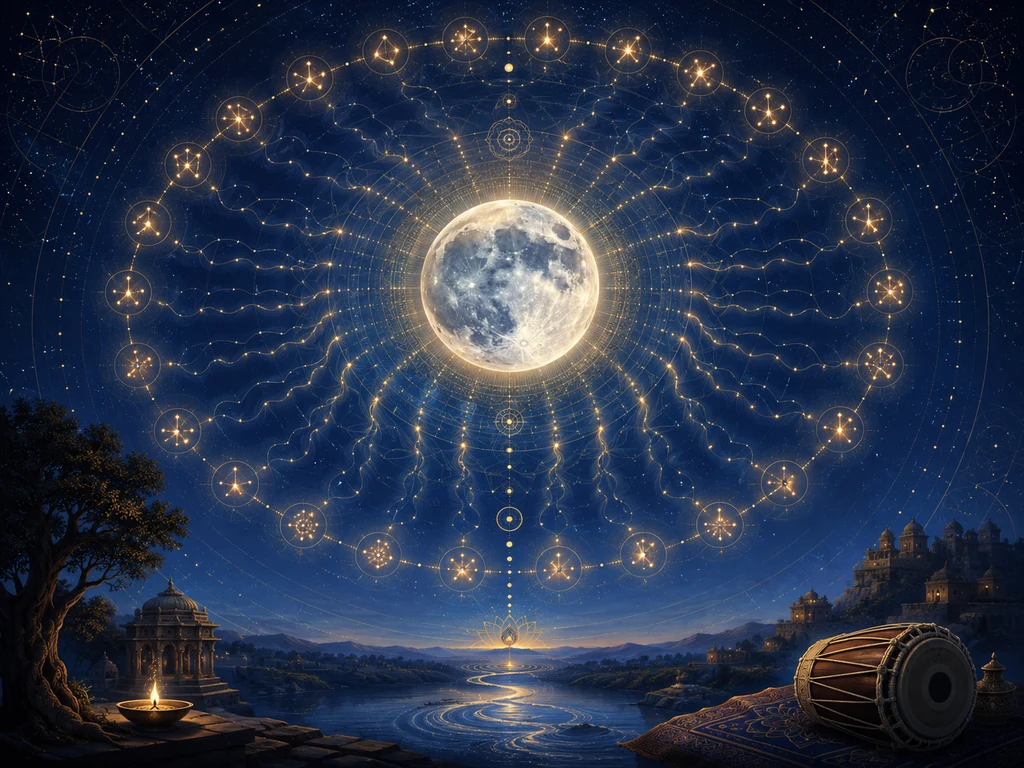
A nakshatra is a lunar mansion: one of the 27 equal divisions of the sidereal zodiac, each measuring 13°20′. The nakshatra occupied by the Moon at birth is called the janma nakshatra, or birth star. Because the Moon moves quickly and is closely tied in Jyotisha to mind, responsiveness, memory, nurture and habit, its exact stellar division gives a finer reading than the Moon sign alone.
The Moon sign covers 30 degrees. A single sign therefore contains parts of three nakshatras, and those sections can operate quite differently. Two people may both have an Aquarius Moon, yet one may be born in Dhanishtha, another in Shatabhisha and another in Purva Bhadrapada. Their emotional style is not identical because the nakshatra lord, symbol, deity, motivation and pada differ.
This is why a sound birth chart reading begins with the exact Moon degree rather than stopping at “Moon in Aquarius” or “Moon in Taurus.” The sign gives the field; the nakshatra gives the mode of movement within that field.
Why does your Moon’s nakshatra set a lifelong rhythm?
The first reason is psychological. The Moon shows the part of us that absorbs atmosphere before the intellect has organised it. Its nakshatra describes recurring instinct: what the mind notices first, what it seeks for safety, how it reacts under pressure and what kind of experience restores equilibrium. That pattern matures, but it rarely disappears.
The second reason is relational. The Moon is not only private feeling; it is the way life is received. A fiery nakshatra does not automatically make someone angry, nor does a gentle one guarantee ease. It shows the texture of response, which is then modified by the Moon’s sign, house, phase, dignity, conjunctions and aspects.
The third reason is timing. In the widely used Vimshottari dasha system, the Moon’s birth nakshatra determines the opening planetary period and the balance remaining at birth. An English translation ofBrihat Parāśara Horā Śāstra presents the proportional calculation from the Moon’s progress through its birth nakshatra, making the lunar position the starting point of a long sequence of major and sub-periods.
“The Moon’s nakshatra does not write every event; it supplies the beat on which the rest of the chart begins to speak.”
That distinction matters. A rhythm is not a verdict. It tells us when certain planetary themes become louder and how the person is likely to process them, but the event itself must be promised by the full horoscope.
How do you read a Moon nakshatra correctly?
Start with the exact sidereal longitude of the Moon. Identify the nakshatra, its ruling planet and the pada, or quarter. Each pada measures 3°20′ and connects the placement to a navamsha sign, adding another layer to motivation and expression. A nakshatra reading without the pada is useful but incomplete.
Then judge the Moon itself. Is it waxing or waning? Is it in its own sign, exaltation, debility or an ordinary sign? Which house does it occupy, which houses does it rule, and is it joined or aspected by benefic or difficult planets? Classical works such as Phaladeepika and Saravali repeatedly judge planetary results through dignity, house placement, lordship, association and aspect rather than through one isolated label. The same discipline must be applied to nakshatras.
Next examine the nakshatra lord. If the Moon is in a Mercury-ruled nakshatra, Mercury becomes a key interpreter of the lunar pattern. Its sign, house, strength and relationships show where that pattern finds an outlet. A strong Mercury may give language, adaptability and discrimination to the Moon’s needs; an afflicted Mercury may produce over-analysis, nervous repetition or mixed signals. The nakshatra lord does not replace the Moon’s sign lord; both must be read.
Finally, compare the Moon with the ascendant and the rest of the chart. The ascendant describes embodiment, direction and worldly engagement. The Moon describes subjective experience and habit. The Sun contributes purpose and authority. When all three repeat a theme, it becomes central. When they differ, the person may feel one way, act another way and pursue a third aim.
For the broader map of all 27 lunar mansions, see the 27 nakshatras in one map rather than turning each symbol into a standalone prediction.
How does the birth nakshatra start Vimshottari dasha?
Vimshottari divides the full cycle into 120 years ruled in the order Ketu, Venus, Sun, Moon, Mars, Rahu, Jupiter, Saturn and Mercury. The sequence is fixed, but the entry point depends on the Moon’s nakshatra at birth. The amount of the first period already elapsed is proportional to how far the Moon has travelled through that nakshatra; only the remaining balance operates after birth.
This is one reason two people born under the same nakshatra can have very different biographies. One may be born near its beginning and receive almost the whole opening dasha. Another may be born near its end and move into the next major period in infancy. Their basic lunar pattern is related, but the timetable is not.
A dasha is not read from its natural symbolism alone. The running planet gives results according to its ownership, placement, strength, yogas, associations and condition in divisional charts. The antardasha, or sub-period, narrows the field further. Transits often act as triggers, but they do not manufacture a promise that the natal chart and dasha do not contain. For the complete method, read Vimshottari dasha explained.
Worked example: Moon at 18° Aquarius
Consider a concrete mini-chart with Virgo rising and the Moon at 18° Aquarius in the sixth house. At 18° Aquarius, the Moon is in Shatabhisha, fourth pada. Shatabhisha is ruled by Rahu, while its fourth pada falls in Pisces navamsha. We therefore have an Aquarius lunar field, a Rahu-led nakshatra pattern and a Pisces undertone operating through the sixth house.
A superficial reading might declare the person “detached, secretive and healing-oriented.” That is too crude. Aquarius makes the Moon process life through systems, groups, principles and distance. Shatabhisha often intensifies the need to investigate what is hidden, irregular or difficult to classify. The Pisces pada can soften the presentation, increase imaginative sensitivity and make boundaries more porous. In the sixth house, these tendencies may be channelled into service, troubleshooting, health routines, conflict management or work that requires sustained attention to defects.
For Virgo rising, the Moon also rules the eleventh house. Its placement in the sixth can connect gains, teams and long-term aims with service, competition, repair work or the solving of other people’s problems. Whether this becomes productive expertise or draining over-involvement depends on the Moon’s strength and the condition of the sixth and eleventh lords.
Now add the rest of the mini-chart. Suppose Saturn, the sign lord, is in Taurus in the ninth house; Rahu, the nakshatra lord, is in Gemini in the tenth; and Jupiter in Libra casts its fifth aspect to the Moon. Saturn in a stable earth sign gives the Aquarius Moon a more practical container. Rahu in the tenth links the lunar pattern with public work, technology, media, unusual professional environments or a non-linear career path. Jupiter’s aspect can add counsel, perspective and an ability to turn difficult experience into useful knowledge.
The dasha calculation makes the example more precise. Shatabhisha runs from 6°40′ to 20° Aquarius. At 18°, only 2° of its 13°20′ span remains, or roughly 15 per cent. Because Shatabhisha is ruled by Rahu, about 15 per cent of Rahu’s 18-year period remains at birth: approximately two years and eight months, before Jupiter mahadasha begins. Exact dates depend on the birth time, ayanamsha and calculation convention, but the principle is straightforward and follows the proportional method described in BPHS.
This changes the reading. Rahu sets the opening atmosphere, but most conscious development may unfold under Jupiter and then Saturn. The natal Moon still keeps Shatabhisha’s rhythm throughout life, yet the planets conducting that rhythm change. A practitioner would therefore avoid predicting an entire life from Rahu alone.
When does the Moon nakshatra become especially active?
The pattern becomes louder during the mahadasha or antardasha of the Moon, the nakshatra lord, the Moon’s sign lord and planets closely joined to or aspecting the Moon. It can also become prominent when slow-moving transits cross the natal Moon, its nakshatra lord or sensitive angles connected with them.
The monthly return of the transiting Moon to the birth nakshatra is a smaller pulse. It is useful for observation: energy, sleep, mood, family concerns and habitual reactions may become easier to notice. It is not a reliable basis for predicting a major event by itself. For accurate daily lunar positions, consult a properly calculated panchang; the Government of India’s Positional Astronomy Centre publishes the Rashtriya Panchang on a modern astronomical basis.
Annual transits should also be read with restraint. Saturn over the Moon may demand emotional economy, responsibility and realism; Jupiter may broaden support, learning or confidence; the nodes may unsettle familiar patterns. None of these statements is complete until house lordship, dasha and the natal promise are checked.
What should you do with your birth nakshatra?
Use it first as an observational tool. Notice the conditions under which your mind becomes clear, scattered, defended or receptive. Track how you respond during the monthly return of the Moon to your birth star. Over several months, the repeated pattern is often more useful than a dramatic one-day prediction.
Use it second to understand timing. A well-prepared astrology report should show the exact Moon degree, nakshatra, pada, dasha balance and the condition of the nakshatra lord. If any of those are missing, the interpretation may be too general to guide a serious decision.
Use it third to refine practice, not to acquire superstition. A mantra, charity, vrata or devotional practice may be appropriate when it fits the person’s tradition and the chart’s actual need. Gemstones should not be prescribed merely because a planet rules the birth nakshatra; strengthening a planet without judging its functional role can be unhelpful. For consequential choices, consult an experienced Jyotisha practitioner who can explain the reasoning rather than issuing a fear-based verdict.
What are the biggest myths about Moon nakshatra?
The first myth is that the birth nakshatra is the only placement that matters. It is central to lunar temperament and dasha timing, but it cannot replace the ascendant, house lords, yogas, divisional charts or planetary strength. A single-factor reading is not classical synthesis.
The second myth is that everyone born in one nakshatra has the same personality or fate. The same birth star can occupy different houses, receive different aspects, belong to different lunar phases and operate through very different nakshatra lords. Even twins may express a shared pattern differently because lived context and choice matter.
The third myth is that a difficult symbol means a difficult life. Nakshatras associated with storms, restraint, cutting, secrecy or endings are not curses. They often describe specialised capacities that become constructive with maturity. Fear enters when imagery is treated literally and context is ignored.
The fourth myth is that a boundary placement can be read casually. Near the end of a nakshatra, a small error in birth time, location, ephemeris or ayanamsha can change the pada or even the nakshatra. The Moon moves roughly 13 degrees in a day, so verification matters. Do not build a life narrative on an uncertain degree.
Is Moon nakshatra more important than Moon sign?
It is more specific, not automatically more important. The Moon sign shows the broader elemental and zodiacal environment; the nakshatra shows the finer instinct and its planetary ruler. Read together, they are stronger than either alone.
A Taurus Moon in Krittika does not function exactly like a Taurus Moon in Rohini or Mrigashira. Yet all three still operate through Taurus themes of stability, embodiment, value and continuity. Specificity should deepen the sign reading, not erase it.
Does birth nakshatra predict marriage or career?
Not by itself. Marriage requires examination of the seventh house and lord, Venus, Jupiter where relevant, the navamsha, dashas and transits. Career requires the tenth house and lord, the Sun, Saturn, relevant yogas, divisional support and timing. The Moon nakshatra shows how the person experiences those areas and which planetary clock begins the sequence.
Nakshatra matching can add useful information in relationship analysis, but it should not be reduced to one score or one prohibition. A complete kundli matching assessment must weigh the whole pair of charts, maturity, health of communication and real-world compatibility.
What if the Moon is near a nakshatra boundary?
Verify the birth data and recalculate with a consistent sidereal ayanamsha. If the Moon remains close to the boundary, read both the ending quality of one nakshatra and the emerging quality of the next, but do not average them carelessly. The exact longitude still decides the formal nakshatra and the starting dasha.
This is also where rectification may help, although rectification should not be used to force a preferred story. It must be tested against timed life events and the rest of the chart.
Can your Moon nakshatra change during life?
The natal Moon nakshatra does not change. It is fixed to the Moon’s position at birth. What changes are the dashas, transits, maturity of the planets and your capacity to express the pattern consciously.
That is the real value of the technique. The rhythm remains recognisable, but you are not required to repeat it at the same level. Astrology can show the beat; practice, circumstance and choice shape the music.
Astrology is best used for guidance and reflection. It is not a substitute for medical, legal or financial advice, and serious decisions should include qualified professional counsel.